
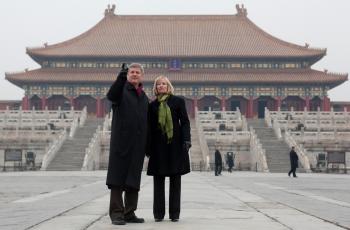
That concern grew in recent days as those officials visits started to land on controversial dates.
When the Conservatives were in opposition, they were a loud voice proclaiming that human rights must not be pushed aside in efforts to strengthen economic ties with China.
Now that the Conservatives are in power, the clamour is gone. The Liberals have usually placed more emphasis on the trade aspect of that relationship, even criticizing Conservative MPs who raised human rights issues. But in recent months, some of the Conservatives’ strong China rights advocates seem to have fallen silent.
Tiananmen Anniversary

Back in Canada, Flaherty told reporters he had not raised human rights or the rule of law over his two days in China.
“I was focusing on economic issues in all my discussions with my Chinese counterparts. Our discussions were limited to those subjects.”
Flaherty was leaving Beijing to join a meeting of G20 finance ministers and central bank governors in Korea, but the timing was not lost on activists back home.
Gloria Fung, a China political analyst and a prominent democracy advocate who was in Tiananmen Square that fateful day 21 years ago, said she was stung.
“Everyone knows that June 4 is the day we mourn for those people who sacrificed their life for democracy in China… Canadian officials should be more considerate than paying an official visit to China on these days that carry a totally different meaning to the Chinese people.”
For Su Ming, the vice-chair of the Canadian branch of the Federation for a Democratic China, Flaherty’s failure to speak out on the anniversary sent a message.
“Human rights in China is getting worse and worse, and right now the Chinese people try to protect their rights and are being cracked down on, pressed by the government all the time.”
“If the international society does not speak out, I think human rights in China will be getting worse.”
Changing Tune
While Canada remains a strong advocate for human rights in China at the United Nations, and the prime minister did raise the issue during his visit to Shanghai last year, top ministers seem to be either changing their positions or leaning more towards the Chinese regime’s perspective.
Although most human rights advocates see a deterioration in human rights in China in recent years, Canada’s Foreign Affairs Minister Lawrence Cannon said after a trip to China in May 2009 that the human rights situation was improving there.
Stockwell Day, who was previously a vocal advocate for rights in China, returned two weeks ago from his most recent China trip as Minister for Asia-Pacific Gateway. He seemed caught off guard when asked what he’d raised regarding human rights and did not answer directly.
“There are always issues related to human rights,” he said. “We don’t separate out any one part of life from another. We talk about the whole picture. We did that on this trip and we’ll continue doing that.”
Yet there were no reports that human rights issues were raised, only statements by Day noting how impressed he was during his trip to China.
“Just got back from a visit to Shanghai’s major port, when I saw the spectacular growth and their plans to expand even further, it underlined an important global reality. That is, the world is coming to China,” he wrote, according to the Globe and Mail.
Similarly, there were no media reports about human rights discussions during Day’s seven-day China visit in April 2009. “I am here to demonstrate that Canada views China as a key economic partner,” Day said in an emailed statement, according to CTV.
Embassy, one of Canada’s most respected political newspapers, described Day’s change from a China critic to promoter as a “U-turn.”
Last July, Transport Minister John Baird returned from an official visit to China gushing about the pace of development there.
“My past viewpoint and past understanding of China has completely changed,” reported an Ottawa-based Chinese newsapper.
Another high-level visit slated for next month has raised the concern further, especially since it could be a propaganda bonanza for China’s state-controlled media.
Another Sensitive Date
That visit is scheduled for July 1, when Governor General Michaëlle Jean will visit China at the request of Prime Minister Stephen Harper and at the invitation of the Chinese regime.
While Jean’s trip will mark the celebration of Canada Day and Canada’s participation at Expo 2010 in Shanghai, the date has another meaning for mainland Chinese—a date that will likely be much more prominently reported on there.
July 1 is the official “birthday” of the Chinese Communist Party and a national holiday. It also marks the day that Hong Kong was returned to Chinese rule, a day marked by annual protests over eroding democratic freedoms.
Fung worries about the implications of the governor general’s visit on that day.
“It is the day they commemorate the founding of the Chinese Communist Party. It will be seen internationally as an endorsement of the Chinese Communist Party.”
In response to questions from The Epoch Times, a spokesperson from the Prime Minister’s Office cited Harper’s speech in Shanghai last year as a clear indication of the government’s position. Harper said:
“Our government believes, and has always believed, that a mutually beneficial economic relationship is not incompatible with a good and frank dialogue on fundamental values like freedom, human rights, and the rule of law… To Canadians, these attributes are inseparable, and Canadians of Chinese origin participate as fully in them as any of our citizens.”
With at least eight senior cabinet members visiting China in the last year, human rights supporters say they'd hoped to see more concrete evidence of this stance in practice.
The Conservatives have another opportunity later this month to raise the human rights issue with Chinese communist leader Hu Jintao coming to Ottawa on June 24, according to Chinese media reports. They have a golden opportunity to use the time to raise the plight of China's oppressed masses.