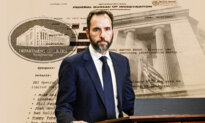

On the grounds of an election conspiracy investigation, the Department of Justice and the FBI under President Joe Biden pursued sensitive and private information on political opponents, including President Donald Trump, his close advisers and lawyers, as well as Republican Congress members and a number of conservative organizations.
Codenamed Arctic Frost, the investigation morphed into a special counsel investigation against Trump in 2023, which was dropped after Trump’s reelection.
Documents recently released by whistleblowers reveal how nearly 200 secret subpoenas sought documents and communications—including call records of eight senators—from hundreds of Republican individuals and organizations.
The probe was opened on the premise that it was criminal of the Trump campaign to arrange alternative sets of electors in states where the campaign was challenging the 2020 election results.
“Subjects corruptly conspired to obstruct the United States Congress’ certification of the 2020 Presidential election results by submitting fraudulent certificates of electors’ votes to the United States Government,” the opening document stated.
There were multiple problems with the legal theory, according to experts, who also said the scope and nature of the investigation were highly irregular and potentially unconstitutional.
Information about the probe has been released over recent months by Trump’s DOJ and Congress Republicans, particularly Sens. Chuck Grassley (R-Iowa) and Ron Johnson (R-Wis.), as well as the House Judiciary Committee.
Arctic Frost was opened on April 13, 2022, by Timothy Thibault, then-FBI Assistant Special Agent in Charge at the Washington Field Office. The following month, Grassley sent a letter to the DOJ and FBI questioning Thibault’s anti-Trump and anti-conservative social media activity. Thibault retired four months later.
The probe appeared to be founded on the premise that whoever raised concerns about the 2020 election results and was in any way connected to the Trump Campaign took part in a conspiracy, noted Hans von Spakovsky, an election law expert and senior legal fellow at the conservative Heritage Foundation.
Consequently, the investigation repeatedly expanded in scope.
At opening, the probe targeted the Trump Campaign, several individuals associated with it, and the roughly 60 alternate electors in Arizona, Georgia, Michigan, Nevada, and Wisconsin.
Already on May 4, 2022, the FBI obtained the government-issued phones of Trump and Vice President Mike Pence, according to internal emails provided by whistleblowers to Grassley and Johnson. At that time, neither was officially a target of the investigation.
Shortly after, Trump and others were added as targets.
On Nov. 18, 2022, the case was taken over by then-Special Counsel for the DOJ Jack Smith for the special counsel investigation, and expanded further still.
Over 400 Republican organizations and individuals were targeted with nearly 200 secret subpoenas seeking documents, financial records, and communications, often going several years back, according to documents provided through whistleblower disclosures to Grassley and which he released on Oct. 29.
The individuals included Trump’s former chief of Staff Mark Meadows, his deputy Dan Scavino, as well as Trump’s lawyers and legal advisers, such as constitutional scholar John Eastmann, former New York City Mayor Rudy Giuliani, and former DOJ official Jeff Clark.
The organizations included conservative youth group Turning Point USA, think tanks America First Policy Institute and America First Legal, as well as the Republican Attorneys General Association.
The pursuit of copious subpoenas on such an open-ended theory of a conspiracy should have been shut down by the DOJ and FBI leadership, according to Horace Cooper, a senior fellow with the National Center for Public Policy Research, who formerly taught constitutional law at George Mason University.
“They should use their prudential judgment to say, ‘Oh no, this is a step too far. There’s not enough here,’” he told The Epoch Times.
His assessment was seconded by von Spakovsky.
“There was no lawful reason for the vast majority of those organizations to be investigated,” he told The Epoch Times.
One document that particularly irked Congress Republicans showed that Smith obtained call records of eight GOP senators, including Johnson, Marsha Blackburn (R-Tenn.), Lindsey Graham (R-S.C.), Bill Hagerty (R-Tenn.), Josh Hawley (R-Mo.), Cynthia Lummis (R-Wyo.), Dan Sullivan (R-Alaska), and Tommy Tuberville (R-Ala.). One House member was also on the list, Rep. Mike Kelly (R-Pa.).
The call logs covered the period of Jan. 4, 2021, to Jan. 7, 2021, the senators were told by FBI Deputy Director Dan Bongino.
In addition, Smith seized the phone of Rep. Scott Perry (R-Pa.) and subpoenaed phone records of Sen. Ted Cruz (R-Tex.). AT&T resisted the subpoena and Smith dropped it, but Verizon complied, Grassley revealed at an Oct. 29 press conference.
READ MORE HERE
—Petr Svab
BOOKMARKS
President Donald Trump on Nov. 14 withdrew the nomination of Donald L. Korb, a veteran tax attorney, to serve as the top lawyer for the IRS, The Epoch Times’ Jacob Burg reported. Korb served in the Bush administration from 2004 to 2008.
U.S. Treasury Secretary Scott Bessent said on Nov. 16 that the government is expecting to finalize a Chinese rare earths deal by Thanksgiving, Nov. 27, The Epoch Times’ Catherine Yang reported. Bessent’s remarks come after news that Beijing is looking into a system to prohibit companies linked to U.S. defense from acquiring rare earths.
A Pennsylvania school district is using artificial intelligence that harnesses Wi-Fi for ’spatial intelligence,’ which the developer claims can locate concealed weapons on students in an effort to keep guns off its campuses. But, The Epoch Times’ Michael Clements reported, civil liberties advocates have warned that the technology could lead to mass surveillance and violation of constitutional rights.
The concept of digital “detoxing” has entered the mainstream, with wellness experts and scientists highlighting its considerable health benefits. But even as the trend grows, The Epoch Times’ Autumn Spredemann reported, some experts say reduced screen time only carries lasting benefits if the lifestyle changes match.