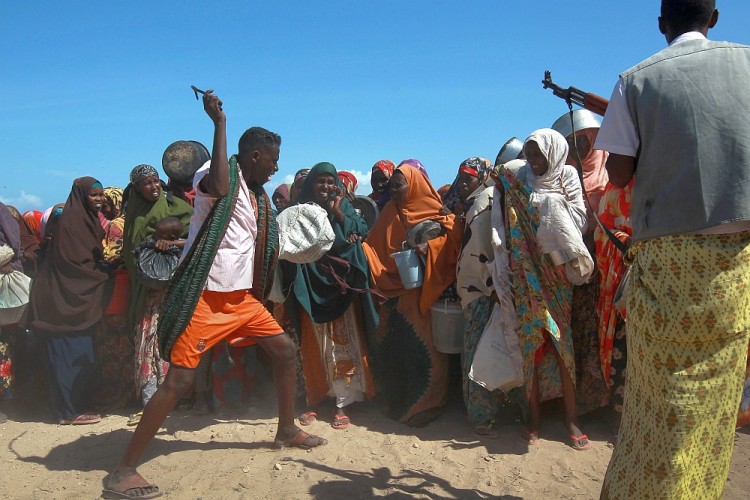
When American official Ertharin Cousin arrived at the Somali refugee reception area in Dadaab, Kenya, she was asked if she wanted to take a picture of food reaching the hungry.
The photo was not meant as a souvenir, but photographic evidence to show donors that aid is being delivered to those in need, not being stolen by gangs as reports are suggesting. Cousin, the U.S. ambassador to United Nations Food and Agriculture Agencies, wrote in her State Department blog post that she declined the offer.
The United Nations World Food Program (WFP) is facing severe scrutiny after the Associated Press published an investigative report earlier this week into where aid ends up after it lands in Somalia. Families told AP that even if they receive aid, they are often forced to return it after an impromptu photo shoot with journalists.
Thousands of bags of WFP food have been spotted in the markets, according to AP and older reports.
An anonymous official in Mogadishu, Somalia, told AP that he estimated that as much as 50 percent of recent aid deliveries have been stolen.
In a published statement from WFP refuting the AP story, the organization says the figure is more like 1 percent, pointing out that stealing 50 percent would take a “huge logistical organization” on par with WFP itself. Every month, the WFP supplies about 5,000 tons of food.
WFP says it has strong controls in place given the challenges of operating in Somalia, including “third party monitors,” and that it has been investigating possible thefts for the past two months.
Given that during times of war, destabilized governments, and humanitarian crisis, aid supplies are particularly appealing to people, theft comes with the territory. Groups vying for power don’t want the aid to reach the enemy and aid represents wealth and power, according to a report on the issue by World Hunger.
“[I]t can be unproductive and naive for aid providers to expect warlords to accept fully the humanitarian principle that victims on all sides of a conflict have equal rights to aid,” says the report.
Humanitarian organizations can subvert thieves, the report says, by disrupting thieves’ “knowledge, opportunity, incentive, and impunity.” For example, a WFP staff member distributed seeds in Afghanistan. In the first year, one group controlled the seeds. But by the second, farmers had grown crops and collected their own seeds to trade and sell so the price of seeds dropped to the point where thieves could no longer make a profit.
Other advice the report gives is to distribute aid immediately when it arrives, since most thefts occur at night.
Theft Not New in Somalia
In 2009, British Channel Four News reported that stocks of maize, cooking oil, and wheat were being illegally sold in the main marketplace of Mogadishu.
In March 2010, the U.N. Monitoring Group for Somalia found that three Somali contractors that WFP relied on for aid distribution were corrupt.
According to their 2010 report, the three had secured 80 percent of WFP’s delivery contracts, part of the Program’s $200 million transportation budget.
WFP contractors maintain some of the largest private militias in southern Somalia, under the premise of distributing aid safely, according to the report.
In these cases, aid has started to legitimize the Somalia war, because it has created the perception that as long as there is war, there will be aid, according to the World Hunger report.
"Enow" is still used as a WFP contractor, according to AP. This comes despite WFP’s claim in 2010 that they would “not engage in any new work with [the three] named in the report.”
The Monitoring Group report named Abdulqadir Mohamed Nur, nicknamed “Enow” as one of the three.
Five regions in southern Somalia have been declared a famine. An estimated 3.2 million people are starving in what may be the worst drought in the Horn of Africa in 60 years. The United Nations has asked for hundreds of millions of dollars in aid.
The situation is complicated by terrorist group al-Shabab that has largely restricted humanitarian access to Somalia since 2010. Two weeks ago, the group was reported to have left Mogadishu, a well-known terrorist stronghold.
Despite the allegations, the WFP will continue to send aid to Somalia, according to their website.