
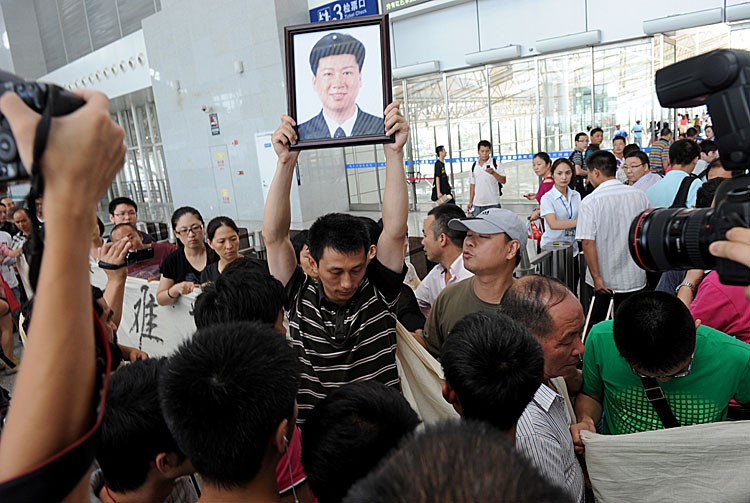
What happened around 8:29 p.m. on July 23, has been put together, piece by piece, but not in any official report. Despite a strict gag order from the Central Propaganda Department, some media outlets and netizens are still digging into the truth about the accident and assigning responsibility to guilty parties.
What Happened
The traffic controller at Wenzhou South Station found that the southbound line toward Wenzhou showed an all red signal zone. That meant there was some dysfunction of the rail or the signal. After making sure that the dysfunction was not caused by the rail but by the signal, the controller turned the control system to abnormal control and ordered the express train D3115, which waited at Yongjia Station, to go. Abnormal control is a manual control status.
The controller also ordered that, once D3115 saw a red signal, it should switch to see and go mode. The train should drive very slowly, guided only by the operator’s naked eye, until it passed the red light zone.
However, the controller didn’t order D301, which was behind D3115 and left Yongjia Station nine minutes later, to switch to the same mode. It is thought the controller must have assumed that the D301 would encounter red signals behind D3115. It didn’t. The driver of the D301 saw all green signals up until the moment he saw D3115 with his own eyes. With D301 traveling at 175 kilometers per hour (108 mph), even though the driver pulled the brake, D301 still hit D3115 at 100 kmph (62 mph).
The driver was killed on impact. So, too, were at least 38 others, according to the official death toll—netizens speculate the actual death toll is in the hundreds.
Insufficient Explanations
If a thunderstorm hadn’t damaged the equipment, things would have been different, or so the Ministry of Railways (MR) would have it. At a July 24, press conference, Wang Yongping, the MR spokesperson, claimed that the crash was caused by equipment damaged by a lightning strike.
This damage could be the reason for the original all red signal zone, but it couldn’t explain the accident. Experts would not accept lightning as an excuse for the crash. In the first place, the railways should have robust measures for preventing damage from lightning. In the second place, even if lightning did damage equipment, operations should still be protected by backup plans and systems.
That the traffic controller apparently made a wrong assumption is also not a sufficient explanation. If the controller did assume the signals behind D3115 would be red, perhaps he did so because he didn’t know the signal equipment used at the Wenzhou Station had serious design problems. The newly appointed head of Shanghai Railways Bureau, An Lushen, admitted this after the crash.
How could a system with serious design problems pass all the approving, testing, and checking for the high-speed trains before it was accepted and put into operation? The same products are widely used on railways all over China, and on many other traffic control systems, including the subways.
Missing Train Protection System
The signal equipment was not the only system with design problems.
Bullet trains around the world are all equipped with an Automatic Train Protection system (ATP). When the MR imported the bullet train technology from Japan, Germany, and France, it didn’t import the ATP system.
In 2007, the MR proudly announced it had a “world class indigenously developed high-speed train protection system.” The current system is called the Chinese Train Control System (CTCS-2). It is said to have track circuits, plus balise (a kind of electronic beacon installed between the tracks), plus ATP, which is functionally equivalent to the European ETCS Level-1.
When the Wenzhou collision happened, most netizens assumed that the system was mistakenly shut down or dysfunctional. In fact, the system was very likely never installed.
According to Wang Mengru, a member of the Chinese Academy of Engineering and professor at Beijing Jiaotong University, the emergency automatic brake for the bullet train is still only a theory in China. The emergency brake for the bullet train depends mostly on the driver’s manual operation. This claim was made during a media interview after the collision.
If this is so, then what is the function of the "world class" CTCS-2? Is it just a low tech, old fashioned manual or semi-automatic system that has been passed off as an ATP system? Such counterfeiting is not without precedent. A few years ago, the Ministry of Industry and Information Technology tried to install Green Dam software in every computer in China, which turned out to be a poor counterfeit of a U.S. company’s software.
Read more: The real significance of the Wenzhou train crash…
Views expressed in this article are the opinions of the author and do not necessarily reflect the views of The Epoch Times.