Many of the worst aches and pains seem to wait until we’re sleeping to come out and play. We’re trapped between two hard places: Stay put and try to roll, fidget, and squirm away from pain, or get up to try to exercise it away, an act that can bring us to full wakefulness and rob us of sleep for the rest of the night.
Having pain doesn’t make for a good night, but there is something we can do to help prevent the intrusion.
6 Exercises to Deter Hurt From Spending the Night
The following exercises can help decrease your risk of hurting in the night. They can be done in the evening before bed and are also beneficial anytime throughout the day to work out the kinks and tightness that can accumulate and sneak up later, as unwelcome intruders of sleep.
My patients generally tolerate these stretches well, but you may want to consult your health care provider to determine if they are suitable for you.
1. Cat/Cow
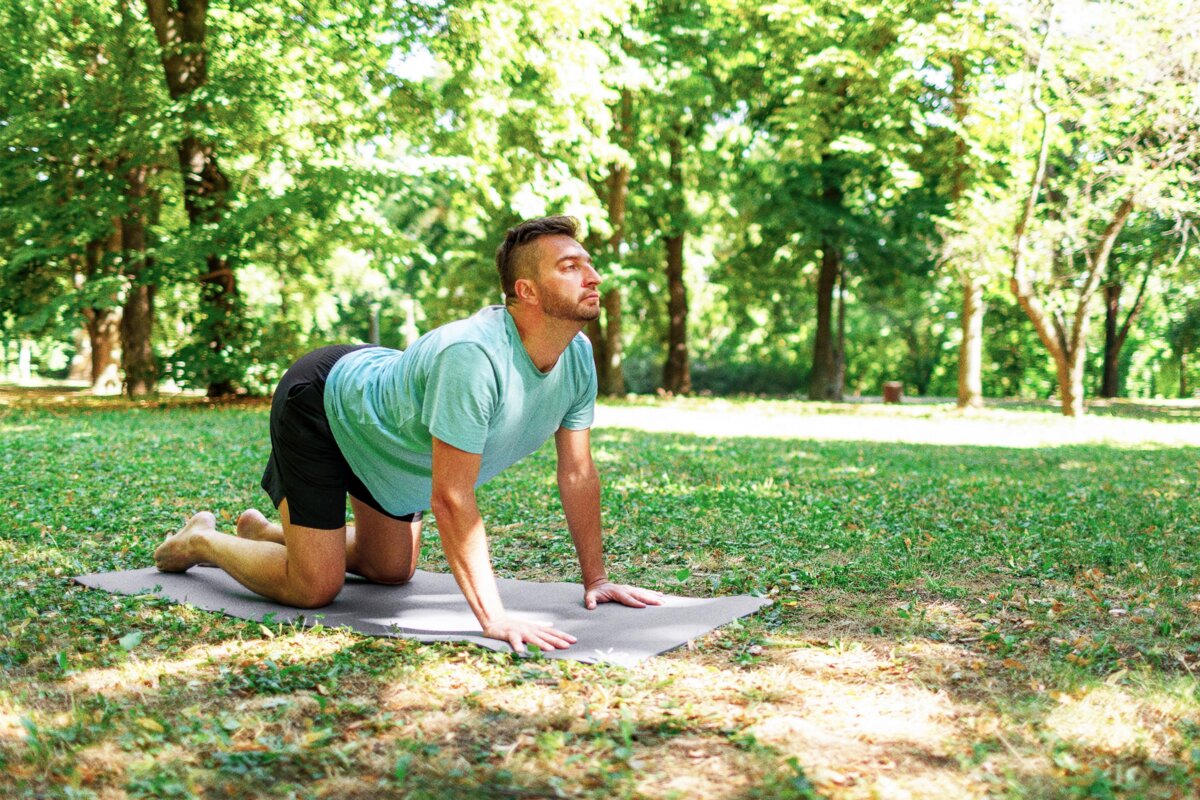
Cat/Cow is an activity you can really throw your back into. The cat/cow movement provides trunk flexion and extension, and is one of the classics of yoga. Stretching out your back right before you go to sleep is a great recipe for better sleep, though you may dream about cats and cows all night.
Practice Tip: You can play with the breath in this pose. Classically, an inhalation accompanies moving into cow and an exhalation into cat. You can also reverse the breath, inhaling through cat and exhaling through cow.
Step 1: Start on your hands and knees on a supportive surface in a table pose. Align your shoulders over your hands and hips over your knees. You can choose a soft surface, such as carpet, if your knees don’t tolerate harder surfaces—another option is to place a cushion under your knees if needed.
Step 2: From the tabletop position, begin at the base of your spine and tuck your tailbone, rolling through the spine one vertebra at a time, until your chin is tucked deeply into your chest and your back is arched upward like a scared cat. Take approximately one to two seconds to move into position, paying attention to what your body is telling you. Hold for five seconds, allowing yourself to relax into the stretch.
Step 3: From the cat position, keep your chin tucked and begin again at the tailbone, rolling through the spine and lengthening it out as you go, until you rise through the crown of your head. As you enter the cow position, keep your nose pointing forward rather than upward to avoid extending the cervical spine. The body should be long and have a slight downward arch between the shoulders and the hips—opposite of cat. As before, take approximately one to two seconds to move into position, and then hold for approximately five seconds before continuing back to cat.
Step 4: Moving through the cat/cow phases is considered one repetition. Try to perform three sets of 12 repetitions.
Modifications: If you can’t move into cat or cow position very far, just move as far as you can—any movement of the spine in these directions will loosen things right up and bring some relaxation to your lower back.
Why I Like It: There’s a reason this is a classic exercise. It provides excellent spinal flexion and extension, from top to bottom.
2. 6-Point Neck Stretch
Nod if your neck hurts. Or maybe don’t nod. Neck pain can follow you to bed, and it’s a light sleeper. Pain in the neck is problematic because it can persist throughout the night, leaving you tired and grouchy in the morning.
Neck Flexion/Extension
Flexion and extension of the neck are great for stretching shortened muscles in the back of your neck during the downward-looking phase. It focuses on the sternocleidomastoid and scalene muscles when looking up, helping to loosen the anterior neck muscles. It can also help you check for spiderwebs in your light fixtures.
Step 1: Standing or sitting, slowly tuck your chin toward the base of your neck while keeping your head upright. Next, slowly move your head upward. These two movements combine to perform a slow nodding movement. Try to perform three one-minute sets.
Neck Rotation
Neck rotations work on your neck muscles in general and also provide excellent vertebral movement.
Step 1: While sitting or standing, slowly rotate your head to the left as far as you comfortably can.
Step 2: Next, move your head slowly to the right, as far as you comfortably can. Try to perform three one-minute sets.
Neck Side Extension
Neck side extension stretching works your sternocleidomastoid and scalene muscles, and also places a great stretch on the trapezius muscles. Those are a lot of strange-sounding muscles, but trust me, they’ll love this movement.
Step 1: Begin this exercise sitting or standing tall, with your head up and looking straight forward. Slowly move your head toward the left shoulder as far as you comfortably can, as if trying to touch your left ear to your shoulder.
Step 2: Move your head back up and then repeat the movement to the right.
Modifications: You can intensify the stretch by placing the knuckles of the hand opposite the direction your head is moving along the small of your back. For example, place the knuckles of your right hand on the small of your back as you flex your neck to the right. This is not a necessary movement, but it can deepen the stretch, especially if you push your hand straight down once your neck has moved as far as it can.
If you can’t move very far in any of the directions, just move as far as you can while remaining free of pain.
Why I Like It: Collectively, these neck movements target all of the neck muscles. They can provide the necessary relaxation you need to get a good night’s rest, especially in the wee hours of the morning when traditional neck aches can wake you.
3. Shoulder Shrugs
Shoulder shrugs seem simple—and they are—but they focus on your upper traps and also your rhomboid muscles. Rhomboid spasms and cramps are particularly vicious, hard to reach, and persistent, and you don’t want them going bump in the night.
Step 1: Either stand with your arms hanging straight down by your sides or sit with your hands resting on the tops of your thighs.
Step 2: Maintaining an upright posture, slowly shrug your shoulders straight up as high as you can and hold for one second. Then slowly lower them back down.
Step 3: Raising your shoulders all the way up and then down counts as one repetition. Try to perform three sets of 15 repetitions, being sure not to speed up as you go. We’re looking for slow, gentle muscle warming and mobilization, not an intense workout pace.
Modifications: If you can’t shrug very high, just do what you can to get a beneficial effect. Also, it can help to watch yourself in a mirror at first, because a surprising number of people struggle to do this movement correctly, compounded by the fact that it’s hard to observe yourself performing the movement.
Why I Like It: This simple exercise is harder—and more effective—than it looks. It’ll tire tight muscles while moving them through a full range of motion, hopefully tucking them quietly in for the night.
[epoch_component type=”related_posts” position=”column-left” section_title=”” width=”” items=””][/epoch_component]
4. Smell-Your-Armpit Stretch
Depending on your hygiene, smelling your armpits might put you to sleep until morning. Seriously, though, this exercise complements the six-point neck stretch by focusing on a deep stretch of the posterior neck.
Step 1: In a sitting or standing position, place your right hand on the back of your head, rotate your head to the right, and then tuck it toward your armpit as if trying to take a whiff of it. Be sure to keep your shoulders up and your back straight.
Step 2: Next, use your right hand to apply gentle pressure to the back of your head, carefully intensifying the stretch. Hold for 10 seconds before returning to the starting position and repeating the movement on the other side.
Step 3: Moving into the stretch and then returning to an upright position counts as one repetition. Try to perform three sets of 10 stretches.
Modifications: If you can’t move very far into this stretch—and many people can’t—just move as far as you can and hold there. Most people will experience an increased range of motion as they go.
Why I Like It: This stretch is deep and thorough, focusing directly on areas that give many people trouble overnight.
5. Supine Windshield Wipers
Hurting hips hinder happiness, especially when you’re trying to get your beauty sleep. Supine windshield wipers can help loosen and stretch your hips, allowing you to sleep better.
Step 1: Begin this exercise on your back, with your knees bent and your feet flat on the surface, approximately 1 foot or as wide apart as they can be.
Step 2: Move your right knee as far and down toward the left as possible. For perspective, if you’re lying on a yoga mat, the knee moves toward the bottom left corner of the mat.
Step 3: Return your legs to the starting position and repeat the movement on the left side. Pressing your knee down and away, then back to center, counts as one repetition. Try to perform 15 repetitions per side.
Modifications: If you can’t rotate your hips far initially, just do what you can. You should loosen up over time. If you like, you can rotate your head in the opposite direction of the leg to warm and open the neck as well.
Why I Like It: This simple exercise can help keep you from getting a hip-check in the middle of the night.
6. Open Book
The open book is a classic lying exercise you can perform from the comfort of your bed. It can help decrease tension across the front of your chest, particularly in relation to your pectoral muscles.
Step 1: Lie on your left side with your right knee crossed over and your left leg straight. With your arms straight out, place your palms together. If you like, you can place support beneath your head and upper knee.
Step 2: Slowly swing your right arm in an arc until you move it as far behind you as you can, following your hand with your eyes while turning your head.
Step 3: Once you’ve moved as far as you can, hold the stretch for five seconds before returning to the closed book position.
Step 4: Moving as far as you can and then back counts as one repetition. Try to perform three sets of 15 repetitions per side.
Modifications: If you can’t rotate very far, just rotate as far as you can. As you hold the stretch, you may achieve more rotation.
Why I Like It: Big stretches deliver big relaxation, and this is a great calming exercise to perform in bed. The open-book exercise can alleviate pain and help you fall asleep all at the same time.
Combined, these exercises can help stretch and loosen muscles and joints, which, in turn, can help you sleep better throughout the night and reduce morning aches. I suggest performing them close to bedtime to make the best use of them, and I hope they work well for you.
About the fitness model: Aerowenn Hunter is a health editor and fitness model for The Epoch Times. Vibrant in her 60s, she’s an accredited yoga therapist who has dedicated three decades to teaching yoga.
Views expressed in this article are the opinions of the author and do not necessarily reflect the views of The Epoch Times. Epoch Health welcomes professional discussion and friendly debate. To submit an opinion piece, please follow these guidelines and submit through our form here.