
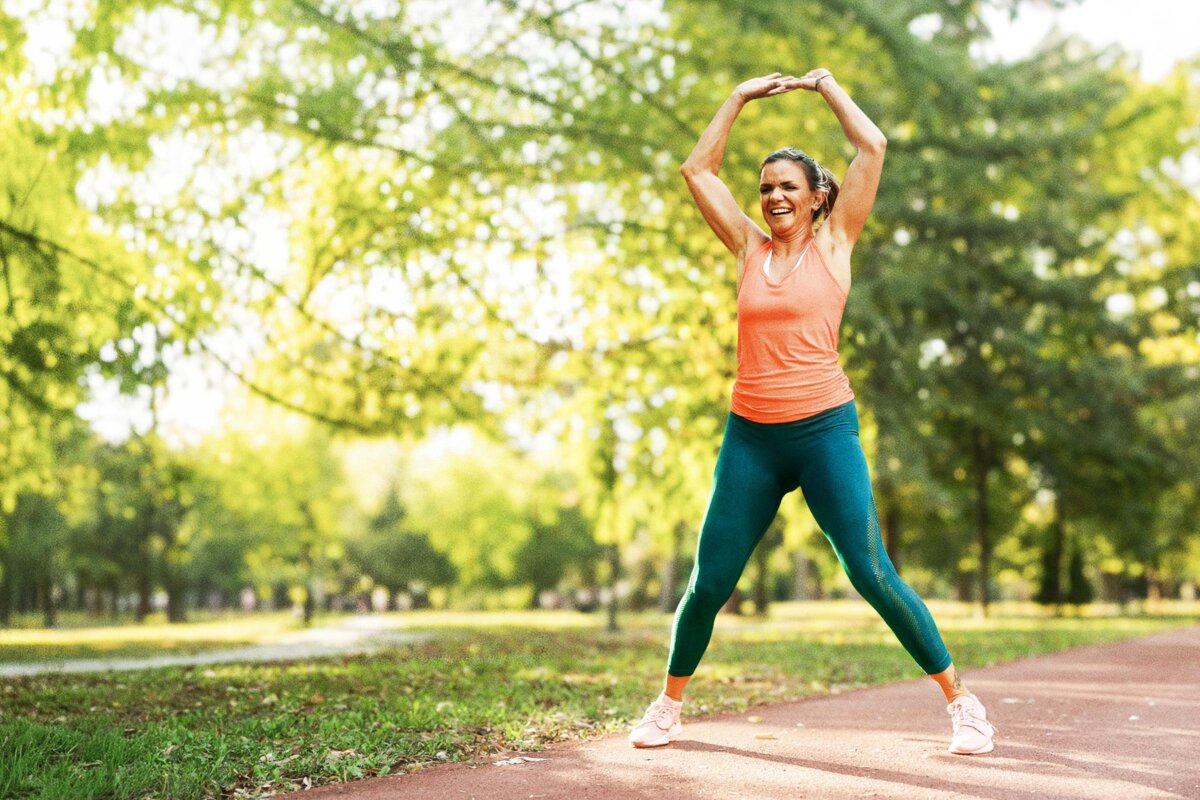
We love many things with all our hearts, but for many of us, unfortunately, our hearts don’t get enough love themselves.
Heart disease and elevated blood pressure are widespread global health issues. Elevated blood pressure can lead to a host of problems and limit your overall quality of life. Worse? High blood pressure is often undetectable, causing considerable harm over the years without ever making its way onto your health radar.
6 Exercises to Help Lower the Pressure
The following exercises can be part of a healthy lifestyle targeted at reducing high blood pressure. They are easy to perform, and my patients generally tolerate them quite well. Still, given the nature of our focus—heart issues—I suggest you consult a medical provider to ensure they are right for you.
1. Walking
Walking has been an integral part of human existence from the start, and it’s one of our greatest tools for mobility. It also works exceptionally well as an exercise.
Step 1: Begin walking at your normal pace, and maintain that speed for five minutes, allowing your muscles, joints, and tendons to warm up.
Step 2: You can either speed up to a fast walk or maintain your current pace, depending on how you feel after the warmup.
Step 3: Continue walking for at least 15 minutes and up to 30.
Step 4: Slow down to your regular walking pace for five minutes if you’ve been walking fast, to allow your body to cool down.
Modifications: Can’t walk fast? Take your time. Even slow walking is amazingly therapeutic.
Why I Like It: Walking is a universal balm, suitable for every joint and muscle in your body—including your heart.
2. Bodyweight Squats
Bodyweight squats work your gluteal and quadriceps muscles hard when performed correctly, and the harder you push them, the more benefit you can gain.
Step 1: Stand on a stable surface with your feet approximately hip-width apart.
Step 2: Slowly sink into a squatting position as you bring your arms up in front of you until your knees reach 90 degrees of flexion. Keep your back straight and your head up as you move.
Step 3: Move slowly back to standing. Avoid springing up—control the movement through the whole range of travel.
Step 4: Squatting down and then standing back up counts as one repetition. Try to perform three sets of 15 repetitions.
Modifications: If you can’t squat deeply, just go as far as you can. You will grow stronger over time.
Why I Like Them: Bodyweight squats provide significant lower-body and core strengthening and, especially as you grow stronger, can also introduce a surprising amount of cardiovascular benefit.
3. Standing Crossover Toe-Touches
Exercises that move your body from high to low and back are generally high intensity by nature, and the standing crossover toe-touch not only is a mouthful to say but also fits this description. Toe touches are also challenging, especially as the repetition count rises.
Step 1: Stand with your feet at least hip-width apart and your arms straight out to your sides.
Step 2: Keeping your back straight and your head up, bend at the hips and touch your left foot with your right hand, then return to standing and repeat on the other side by touching your right foot with your left hand.
Step 3: Touching your foot with a hand counts as one repetition. Try to perform three sets of 20 toe-touches per side. You can perform all repetitions on one side and then the other, or alternate sides as you go, which is what I prefer.
Modifications: If the up-and-down movements make you dizzy, feel free to slow the rate of activity or limit how far down you go to counteract the effect. You can also—and I recommend—stop performing the exercise until you feel better. If you can’t reach down very far, just go down as far as you comfortably can, understanding that you will get better with practice.
Why I Like Them: Standing crossover toe-touches challenge your balance while giving you a great cardiovascular workout.
[epoch_component type=”related_posts” position=”column-left” section_title=”” width=”” items=””][/epoch_component]
4. Standing March
The standing march is an effective exercise when you can’t get out for a walk. Even if you do go walking, it’s a great follow-up exercise that provides additional benefits. It can also serve as a rejuvenating break from sitting during work hours without even having to leave your desk.
Step 1: Stand with your feet side by side, your arms by your sides, your back straight, and your head facing forward. Lift your right leg off the floor until your knee and hip reach 90 degrees of flexion. Move your opposite arm in rhythm with the march.
Step 2: Lower your right leg and lift your left leg. Combined, the left and right movements create a standing march. I recommend taking at least one second to move through the leg lifts, keeping your stomach and core muscles tight and breathing through the activity.
Step 3: Each leg lift counts as one repetition. Try to do 50 repetitions per set and perform three sets. Alternatively, you can march for three to five minutes, take a brief rest, and repeat three more times.
Modifications: You can stabilize off a wall, chair, or countertop if needed. If you can’t raise your legs high, just raise them as high as you can. You can also slow the activity down or speed it up as much as you like to suit your needs or likes.
Why I Like Them: This small-space activity benefits both your balance and your endurance.
5. Stepping Jacks
Stepping jacks are a highly rhythmic exercise that’s easy for almost everyone to master. This exercise can get you huffing and puffing to a healthy heart rate if you do it enough, yet it is mild on the joints and easy to do anywhere.
Step 1: Stand with your arms at your sides and your feet side-by-side. Step to the right with your right foot, then lift your arms out to the sides and over your head.
Step 2: Bring your left foot side-by-side with your right foot while simultaneously lowering your arms.
Step 3: Reverse the pattern, stepping to your left with your left foot while simultaneously raising your arms, then stepping with your right foot while lowering your arms back to your sides.
Step 4: Stepping out with either foot is considered one repetition. Try to perform three sets of 30 repetitions.
Modifications: If you can’t step out far to either side, just step out as far as you can. Can you move farther out with one side than the other? That’s perfectly OK—and not at all uncommon.
Why I Like Them: Stepping jacks facilitate overhead reaching and introduce a significant cardiovascular component, one my patients are surprised to encounter—and a positive outcome.
6. Skater Hops
Skater hops are one of my go-to exercises. They are easy to perform anywhere but demanding enough to provide a strong cardiovascular component, which can help give your heart the tune-up it needs and help decrease blood pressure.
Step 1: Stand with your feet close together and your hands by your sides.
Step 2: Hop approximately 2 feet to the right. As you land on your right foot, keep your left foot in the air and allow it to swing behind you with its momentum. You can either keep your arms still, hold them straight out in front of you, or get them into motion by moving your arms as you would if you were running.
Step 3: Hop the same distance back to the left, letting the right leg swing behind you.
Step 4: Hopping in one direction counts as one repetition. Try to complete three sets of 20 repetitions.
Modifications: If you can’t hop far, hop as far as you can—even if it’s only a teensy little bit. You’ll get better over time.
Why I Like Them: Building on the lateral movement of the stepping jacks, this exercise includes a hopping motion that magnifies both your effort and the benefits all at the same time.
Together, these exercises can be part of a larger healthy-heart lifestyle that can help you either stave off high blood pressure or help control it—and finally allow you to give your loving heart all the love it truly needs. I hope they work well for you.
About the Fitness Model: Aerowenn Hunter is a health editor and fitness model for The Epoch Times. Vibrant in her 60s, she’s an accredited yoga therapist who has dedicated three decades to teaching yoga.
Views expressed in this article are the opinions of the author and do not necessarily reflect the views of The Epoch Times. Epoch Health welcomes professional discussion and friendly debate. To submit an opinion piece, please follow these guidelines and submit through our form here.